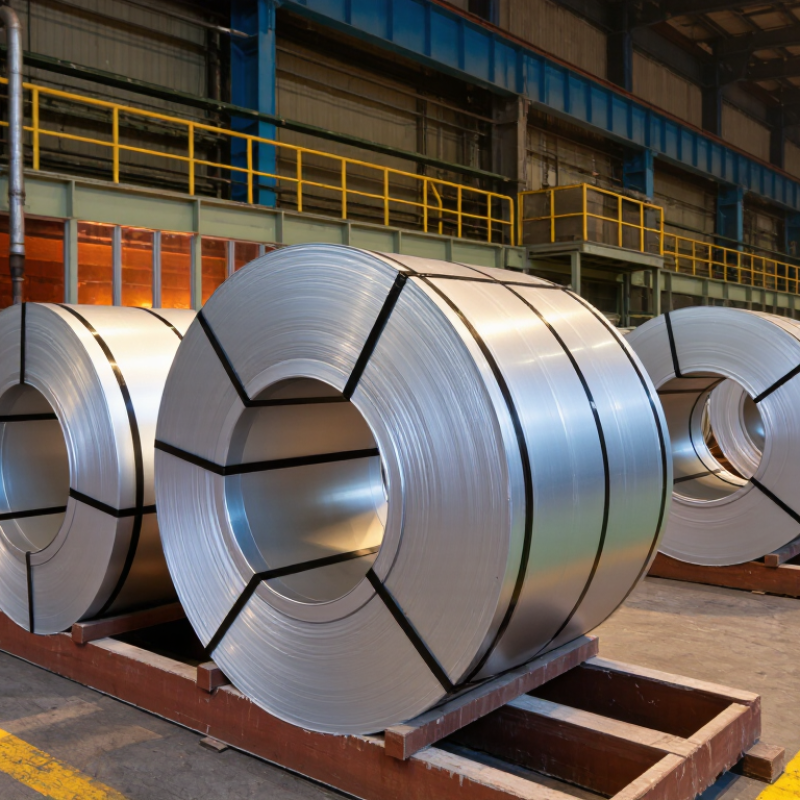
What Is a Galvanized Steel Coil Manufacturer?

A Galvanized Steel Coil Manufacturer does more than apply zinc to flat steel. It controls chemistry, coating weight, surface quality, and delivery consistency. In a continuous hot-dip line, cleaned steel passes through a molten zinc bath near 450°C. Air knives then regulate the coating thickness. Small variations can affect forming, welding, painting, and service life.

The World Steel Association reported approximately 1.89 billion tonnes of crude steel production worldwide in 2023. Its World Steel in Figures 2024 also highlights steel’s continuing importance across construction, transport, energy, and manufacturing. Galvanized coil supports these sectors because its zinc layer helps protect exposed steel from atmospheric corrosion. Common coating designations, such as Z100 or Z275, describe the total zinc mass on both surfaces, measured in grams per square metre. The specification must match the application. More zinc is not automatically better.

Edwin Basson, Director General of the World Steel Association, has stated, “Steel is the most recycled material in the world.” That observation matters to manufacturers planning long-term material strategies. Responsible producers increasingly monitor recycled content, energy use, coating efficiency, and process emissions. However, published market forecasts often differ because they use different regional boundaries and product definitions. That uncertainty deserves attention. A reliable Galvanized Steel Coil Manufacturer should therefore provide mill certificates, coating test results, dimensional tolerances, and traceable batch information. The coil may look ordinary on a warehouse rack. Its performance depends on invisible controls established long before shipment.

What Is a Galvanized Steel Coil Manufacturer?

What a Galvanized Steel Coil Manufacturer Produces: Steel, Zinc, and Coils

What Is a Galvanized Steel Coil Manufacturer?

A galvanized steel coil manufacturer produces coated steel for roofing, construction, automotive parts, and industrial equipment. Its main materials are steel, zinc, and carefully controlled processing conditions. Most manufacturers begin with cold-rolled or hot-rolled steel strip, rather than making steel from raw iron. This distinction matters when comparing suppliers.

The steel strip passes through cleaning, annealing, and a molten zinc bath. Zinc forms a protective layer that helps reduce corrosion. The coated strip is then cooled, inspected, and rewound into coils. Operators check coating weight, strip thickness, surface appearance, width, and zinc adhesion. Some coils receive additional treatments, such as skin passing or tension leveling, to improve flatness. A bright surface is useful, but it does not prove consistent quality. Coating measurements and test records are more reliable. In practice, small surface marks may appear, so buyers should define acceptable limits clearly.

Tips: Ask about the steel grade, zinc coating mass, coil weight, dimensions, and inspection method. Confirm whether the manufacturer controls the coating line directly. Request sample data before placing a large order. Delivery performance matters too. A technically strong product can still create problems if packaging, labeling, or storage guidance is weak. Good communication prevents avoidable mistakes, although specifications sometimes need revision after real production trials.

How Hot-Dip Galvanizing Applies Zinc Coatings from 30 to 275 g/m²

What Is a Galvanized Steel Coil Manufacturer?

A galvanized steel coil manufacturer produces flat steel strip with a controlled zinc coating. The coil moves through a molten zinc bath, usually near 450°C. Air knives then regulate the coating thickness before cooling and recoiling. This process creates the familiar zinc layer that protects exposed steel from moisture and corrosion.

Hot-dip specifications commonly range from 30 to 275 g/m². This value usually describes the combined zinc mass on both surfaces. A 275 g/m² coating provides a heavier protective layer than 30 g/m², but it also changes forming behavior, surface appearance, and material cost. EN 10346 defines coating designations and testing requirements for continuously galvanized flat products. ISO 1461 provides related guidance for batch-galvanized steelwork. These standards show why coating mass must match the intended service environment.

Small details matter. A manufacturer checks bath chemistry, strip speed, air pressure, and surface cleanliness. Uneven cleaning can create bare spots or weak adhesion. Excessive air pressure may reduce coating mass, while poor control can leave zinc buildup along the edges. Technical guidance from the International Zinc Association notes that corrosion life depends on coating thickness, atmosphere, moisture, and damage. The number alone is not enough. A purchasing specification should state coating mass, test method, steel grade, surface quality, and dimensional tolerances. Even then, real exposure can differ from laboratory expectations. That gap deserves careful review.

Which Standards Govern Galvanized Coils: ASTM A653, EN 10346, and JIS G3302

What Is a Galvanized Steel Coil Manufacturer?

A galvanized steel coil manufacturer produces steel coils with a protective zinc coating. The process usually includes cleaning, annealing, hot-dip galvanizing, cooling, and recoiling. Quality depends on more than a bright surface. The manufacturer must control coating weight, strip tension, zinc-bath temperature, surface finish, and edge condition. Traceability also matters. Each coil should connect to test results, production records, and a clear specification.

ASTM A653/A653M is widely used in North America. It defines steel grades, coating designations, dimensions, and mechanical requirements for zinc-coated sheet. EN 10346 covers continuously hot-dip coated flat products in European applications. It commonly uses grades such as DX51D and coating designations such as Z. JIS G3302 applies to hot-dip zinc-coated steel sheet and strip, with grades including SGCC. These systems are not interchangeable by name alone. Their coating masses, tolerances, testing methods, and designation rules can differ. A capable manufacturer checks the required standard, grade, coating class, surface treatment, and intended forming process before production. Small details matter.

Tips: Request the complete standard edition and coating designation. Confirm whether the order requires spangle control, passivation, oiling, or special surface quality. Compare mechanical test values, not only grade labels. Inspect the certificate against the coil number. This step is often skipped. It should not be. Standards may also be revised, so relying on an old table can create avoidable errors. When requirements are unclear, a technical review is wiser than a quick substitution.

How Manufacturers Control Coil Thickness, Width, Surface Quality, and 600–1,850 mm Sizes

What Is a Galvanized Steel Coil Manufacturer?

How Manufacturers Control Coil Thickness, Width, Surface Quality, and 600–1,850 mm Sizes

A galvanized steel coil manufacturer turns rolled steel into corrosion-resistant coils through controlled cleaning, heating, and zinc coating. The work begins with the customer’s required grade, thickness, width, and coating weight. Typical coil widths may range from 600 to 1,850 mm. Each size demands suitable rolling pressure and line tension.

Thickness control depends on calibrated gauges placed along the processing line. These sensors detect small changes while automatic systems adjust the rolls. Width is managed through accurate slitting, edge trimming, and stable strip alignment. A few millimeters can affect forming performance. Small errors matter.

Surface quality requires more than a bright appearance. Operators check zinc coverage, adhesion, roughness, stains, scratches, and edge condition. They may inspect samples under strong lighting and record results by coil number. The surface tells.

Experienced teams also control strip temperature, cleaning strength, air-knife pressure, and cooling speed. These details influence zinc distribution and later painting performance. Traceable inspection records support reliable delivery. However, no production line is perfect. Vibration, worn tooling, or an unnoticed sensor drift can create defects. Careful manufacturers investigate these events instead of hiding them. That habit builds technical credibility and improves future batches.

What Is a Galvanized Steel Coil Manufacturer? — How Manufacturers Control Coil Thickness, Width, Surface Quality, and 600–1,850 mm Sizes
Control Dimension Typical Industry Data How Manufacturers Control It Typical Verification Method
Product definition Cold-rolled or hot-rolled steel strip coated with zinc by a continuous hot-dip galvanizing process. The zinc coating protects the steel substrate from atmospheric corrosion. Steel strip is cleaned, annealed or heat-treated when required, passed through a molten zinc bath, air-wiped, cooled, inspected, and recoiled. Production records, coating-process logs, mechanical testing, dimensional inspection, and surface-quality inspection.
Nominal steel thickness Approximately 0.30–3.00 mm Automatic gauge control adjusts rolling conditions and maintains a stable strip tension. Thickness compensation is applied for changes in rolling force and temperature. Online X-ray or isotope thickness gauges, calibrated micrometers, and sampling across the strip width.
Finished galvanized thickness Finished thickness equals the steel substrate thickness plus the zinc coating contribution. A two-sided coating mass of 275 g/m² adds approximately 0.039 mm to total thickness, assuming a zinc density of about 7.14 g/cm³. Substrate gauge and zinc coating weight are controlled separately so the finished product remains within the ordered dimensional tolerance. Thickness readings at the center and edge zones, combined with coating-mass test results.
Available coil width Approximately 600–1,850 mm Slitting, trimming, entry-centering, and line-width settings are selected according to the required order width. Wide-strip production is normally limited by the galvanizing line and recoiler capacity. Calibrated width gauges, edge sensors, and multiple width measurements along the coil.
Common width groups 600–899 mm; 900–1,199 mm; 1,200–1,499 mm; 1,500–1,699 mm; 1,700–1,850 mm. Manufacturers use automatic strip-centering systems and edge-trimming equipment to maintain a consistent usable width. Width inspection at the head, middle, and tail portions of the coil, with edge-condition checks.
Zinc coating mass Common total coating ranges: approximately 60–350 g/m² for both sides; selected specifications may be lower or higher. An air-knife system removes excess molten zinc. Air pressure, knife-to-strip distance, strip speed, bath temperature, and zinc-bath chemistry influence coating mass and uniformity. Gravimetric coating-mass testing, magnetic or electromagnetic coating gauges, and measurements on both sides of the strip.
Coating distribution Typical orders specify either an equal coating on both sides or a controlled differential coating, depending on the application. Air-knife pressure and positioning are adjusted independently where differential coating is required. Strip alignment prevents edge-to-edge coating imbalance. Coating-mass readings from the top and bottom surfaces at the center and quarter-width positions.
Surface quality Common surface classifications include regular spangle, minimized spangle, or spangle-free appearance. Surface quality may be specified as commercial, exposed, or forming quality depending on the applicable standard. Bath chemistry, cooling rate, wiping conditions, roll cleanliness, strip tension, and handling practices are controlled to reduce zinc lumps, scratches, roll marks, bare spots, and pinholes. Visual inspection under controlled lighting, surface comparison samples, and automated camera inspection where available.
Surface finish and roughness Surface appearance is selected according to end use, such as roofing, construction panels, stamping, appliance parts, or painting. Roughness is controlled when paint adhesion or forming performance is important. Skin-pass rolling, tension leveling, roll finishing, and clean material handling are used to improve flatness and surface consistency. Visual inspection, roughness measurement, paint-adhesion testing, and forming trials when required.
Flatness and shape Flatness requirements vary by product standard and application. Typical defects monitored include edge wave, center buckle, coil set, and crossbow. Tension leveling, skin-pass reduction, roll alignment, strip-tension control, and controlled recoiling reduce shape defects. Level-table inspection, straightedge checks, shape gauges, or an online shape-measurement system.
Width tolerance Usually controlled according to the ordered product standard, such as EN 10143, ASTM A924/A924M, or an equivalent national standard. The exact tolerance depends on nominal width, thickness, and edge condition. Automatic width control, precision side trimming, edge tracking, and scheduled tool maintenance reduce width variation. Calibrated steel rules, laser width gauges, and inspection at several positions along the coil.
Thickness tolerance Usually controlled according to the applicable standard and ordered tolerance class. Tolerance becomes more demanding when tighter dimensional control is specified. Closed-loop gauge control, rolling-force adjustment, stable strip tension, and regular gauge calibration maintain thickness consistency. Online thickness monitoring plus micrometer readings across the width and along the coil length.
Coil inside diameter Commonly 508 mm or 610 mm Recoiler mandrel selection and expansion pressure are matched to the customer’s processing equipment and required coil weight. Inside-diameter gauge, mandrel records, and visual checks for coil collapse or telescoping.
Coil outside diameter and mass Often approximately 1,000–2,000 mm outside diameter, with coil mass commonly ranging from several tonnes to more than 20 tonnes, depending on thickness, width, line capacity, and transport limits. Recoiling tension, coil-length calculation, maximum coil diameter, and crane or vehicle limits are established before production. Weighbridge or coil scale records, outside-diameter measurement, and packaging inspection.
Edge condition Mill edge or slit edge may be supplied. Slit edges generally have tighter width control but may require additional burr and edge-quality requirements. Side trimming, slitting knives, burr control, edge sensors, and tool-condition monitoring are used to maintain clean edges. Visual inspection, burr-height measurement, and edge-profile checks.
Applicable standards Common references include EN 10346 for continuously hot-dip coated steel flat products, ASTM A653/A653M for zinc-coated steel, and JIS G3302 for hot-dip zinc-coated steel sheet and strip. The manufacturer confirms the required grade, coating designation, dimensional tolerance class, surface quality, testing frequency, and certificate requirements before production. Mill test certificate, chemical analysis, mechanical-property testing, coating-mass results, and dimensional inspection reports.
Final quality release A compliant coil normally includes identification of grade, nominal thickness, width, coating designation, coil mass, coil number, and applicable standard. Quality personnel review inspection data before labeling, packaging, and dispatch. Nonconforming sections may be downgraded, reprocessed, or removed. Final release checklist, certificate review, traceability records, and customer-specific inspection documentation.
Note: Actual tolerances, coating designations, coil weights, and available width combinations depend on the applicable product standard, steel grade, galvanizing line capacity, edge condition, and customer specification.

How Galvanized Steel Coil Manufacturers Test Coating Mass, Adhesion, Strength, and Corrosion Resistance

A galvanized steel coil manufacturer does more than apply zinc. It must prove that the coating survives processing and service. Global crude steel production reached about 1.89 billion tonnes in 2023, according to World Steel Association’s World Steel in Figures 2024. At that scale, repeatable testing matters.

Technicians measure coating mass using gravimetric stripping under ASTM A90/A90M or rapid X-ray fluorescence checks. ASTM A653/A653M classifies common coatings, such as G90, at about 275 g/m² across both surfaces. The result can vary near edges, so samples should come from several coil locations. Adhesion testing uses controlled bending. A coating that flakes after forming is not acceptable, even when its mass looks correct. Tensile tests follow ASTM A370, checking yield strength, tensile strength, and elongation. These values reveal whether the coil can withstand stamping without unexpected cracking.

Tips: Ask for heat numbers, test locations, calibration records, and actual results. Do not accept only a “passed” statement.

Corrosion resistance needs context. Salt-spray testing under ISO 9227 or ASTM B117 exposes prepared panels to a controlled salt fog. Hours to red rust can compare batches, but they do not perfectly predict outdoor life. Surface preparation, cut edges, humidity, and pollutants change performance. This is where manufacturers sometimes oversimplify. A thick coating may still fail at a damaged edge. A strong coil may still show poor adhesion after forming. Reliable quality control combines laboratory data with production experience, though even experienced teams should question unusually perfect results.

Galvanized Steel Coil Coating Mass by ASTM Designation

Minimum total coating mass for both sides of galvanized steel sheet, converted from ASTM A653/A653M coating designations.

Coating mass is commonly verified by gravimetric or magnetic testing. In ASTM designations, G30, G60, G90, and G115 correspond to approximately 91.5, 183.1, 274.6, and 350.9 g/m² respectively, based on 1 oz/ft² = 305.15 g/m². Adhesion is evaluated through bend testing, mechanical strength through tensile testing, and corrosion resistance through standardized exposure tests such as salt spray.

Scroll to Top