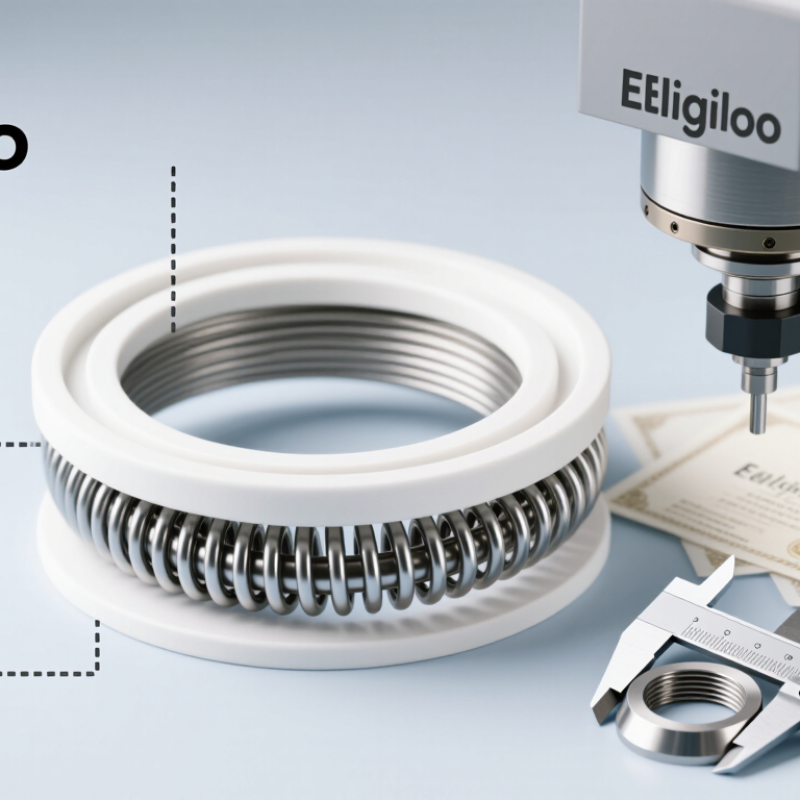
China Best PTFE Elgiloy Lip Seal Manufacturer?

Choosing the China Best Ptfe Elgiloy Lip Seal Manufacturer requires more than comparing unit prices. Seal performance depends on material quality, machining accuracy, spring design, and application conditions. A reliable supplier should explain each factor clearly.

A Ptfe Elgiloy Lip Seal combines low-friction PTFE with a corrosion-resistant Elgiloy energizer. This structure supports demanding rotary and reciprocating applications. It can perform in chemical processing, hydraulic equipment, pumps, and high-temperature machinery. However, no seal suits every operating environment. Pressure, shaft speed, temperature, media compatibility, and installation quality must be reviewed together.

Practical manufacturing experience matters. Skilled suppliers normally provide controlled molding, precision machining, cleaning, inspection, and traceable batch records. They should also discuss lip geometry, surface finish, spring load, and tolerance requirements before production. Test evidence is valuable. Useful records may include leakage checks, dimensional reports, material certificates, and application-based validation.

Look closely at communication.

A professional manufacturer asks specific questions instead of promising universal performance. Samples, drawings, and operating data should support the selection process. Technical engineers can then recommend a suitable grade, profile, and Elgiloy configuration. Customization may improve sealing stability, but it can also increase development time and cost.

Some online claims remain vague. That deserves caution. A supplier may have strong production equipment but limited experience with your media or speed range. The better choice is a manufacturer that combines documented quality control, responsive engineering support, realistic lead times, and transparent limitations. This article examines the key factors behind a dependable Chinese supplier and explains how buyers can evaluate Ptfe Elgiloy Lip Seal quality with greater confidence.

China Best PTFE Elgiloy Lip Seal Manufacturer?

PTFE Elgiloy Lip Seals: Definition, Structure, and Operating Principles

PTFE Elgiloy lip seals are engineered sealing components for rotating shafts, reciprocating rods, and demanding fluid systems. Their sealing element uses polytetrafluoroethylene, known for low friction and strong chemical resistance. An Elgiloy spring or energizer supports the PTFE lip under changing conditions. The lip touches the shaft with controlled pressure, limiting fluid leakage and preventing contaminants from entering.

The structure normally includes a precision-machined PTFE sealing ring, a metallic energizing spring, and sometimes a protective housing. During operation, system pressure pushes the lip against the shaft, improving contact on the pressure side. The spring maintains sealing force when pressure falls. A microscopic lubricant film should remain between the lip and shaft. Too much contact creates heat, while too little contact causes leakage.

In practical installation work, shaft finish and alignment often decide performance. A clean shaft, a suitable chamfer, and careful stretching can prevent lip damage. Sharp edges are unforgiving. Temperature, pressure, speed, and media compatibility must be checked together, not separately.

PTFE can creep under sustained load, so an unsupported design may lose contact over time.

This limitation is easy to overlook.

I would also recheck spring material selection in humid or corrosive service, because small corrosion marks can change the sealing load. Testing with the actual fluid remains more reliable than relying only on catalog values.

Key Performance Standards for Selecting a Chinese Manufacturer

Choosing a Chinese PTFE Elgiloy lip seal manufacturer requires measurable performance, not attractive catalog language. Start with operating data: pressure, shaft speed, temperature, media, and expected service hours. PTFE seals should be tested for leakage, friction, wear, and dimensional stability after thermal cycling. The spring material also needs verified corrosion resistance and consistent load.

Evidence matters more than claims. The U.S. Department of Energy reports that compressed-air leaks can waste 20–30% of compressor output in poorly maintained systems. This shows why small seal defects can create significant operating losses.

Request test records using recognized methods, including leakage measurement, hardness checks, and material identification. ISO 9001 certification supports process control, but it does not prove seal performance. Ask for batch traceability, inspection limits, and samples from normal production.

Tips:

  • Compare at least three suppliers.
  • Require a signed drawing and material certificate.
  • Check spring force after repeated compression.
  • Review test results at your actual temperature and speed.
  • A supplier should explain failure limits clearly.
  • I would not trust one impressive sample.
  • Production variation remains a real risk.
  • Also, confirm whether “Elgiloy” means the specified cobalt-based alloy or an unverified substitute.
  • Independent laboratory testing may cost more, but it can reveal leakage, swelling, or friction problems before field installation.
  • Be practical. Perfect predictions are rare.

Manufacturing Processes and Quality Control for PTFE Elgiloy Seals

China Best PTFE Elgiloy Lip Seal Manufacturer?

Manufacturing PTFE Elgiloy lip seals begins with controlled material preparation. PTFE resin should be verified against ASTM D4894 requirements before blending and molding. The cobalt-chromium alloy spring needs incoming inspection for chemistry, hardness, and corrosion resistance.

Small defects matter. A burr of 0.02 millimeters can damage the sealing lip during assembly.

The molding process uses controlled pressure and temperature, followed by precision machining. Operators measure lip geometry, spring force, surface roughness, and concentricity.

Typical inspection records should identify the resin lot, alloy batch, machine, operator, and inspection equipment. ASTM F36/F36M methods can support compression and recovery evaluations, although they do not represent every operating condition. That limitation deserves attention.

Quality control must continue through leak testing and dimensional verification. Helium or pressure-decay testing can reveal leakage paths that visual inspection misses.

The ISO Survey 2022 reported 1,265,216 ISO 9001 certificates across 189 countries and economies, showing how widely documented quality systems are used. Certification alone proves little without process evidence.

A reliable manufacturer therefore reviews control charts, calibration records, and rejected parts. Some suppliers still test only finished samples. That practice is efficient, but risky. Temperature cycling, shaft-speed variation, and lubricant compatibility should be evaluated for the actual application.

Applications, Customization Options, and Compatibility Considerations

PTFE lip seals with corrosion-resistant spring energizers are used in pumps, hydraulic cylinders, mixers, and rotating shafts. They perform well where chemicals, moisture, or wide temperature changes challenge elastomer seals. A typical application may involve a polished shaft, low friction requirements, and intermittent pressure. Seal performance depends on the complete system, not PTFE alone.

Customization should match the operating details. Manufacturers can adjust lip geometry, spring force, seal diameter, backup features, and PTFE compound. Fillers may improve wear resistance or reduce friction, but they can change shaft compatibility. Pressure, speed, temperature, media, and installation space must be reviewed together. A seal that works in dry air may fail quickly in abrasive slurry. In practice, the first material choice is sometimes wrong. Testing exposes this early.

Tips: Share shaft hardness, surface finish, runout, pressure cycles, and chemical exposure with the manufacturer. Check dynamic and static sealing conditions separately. Confirm spring alloy compatibility with the process fluid. Avoid copying an old seal without checking equipment changes. A small groove error matters. Field feedback is valuable, but it should support measured test data. Sample testing under real temperature and speed conditions often reveals problems that catalog tables miss.

China Best PTFE Elgiloy Lip Seal Manufacturer? - Applications, Customization Options, and Compatibility Considerations
Evaluation Dimension Typical Specification or Option Application Value Compatibility or Design Consideration Recommended Selection Status
Seal Construction Spring-energized PTFE lip seal using a corrosion-resistant cobalt-chromium alloy energizer Maintains lip contact when PTFE has limited elastic recovery, helping support sealing at low pressure and during thermal cycling The energizer should remain protected from direct exposure when the process medium or cleaning chemistry is aggressive Common configuration
Primary Sealing Material Virgin PTFE Low friction, low moisture absorption, broad chemical resistance, and suitable performance in many static and dynamic sealing applications Virgin PTFE has lower wear resistance than filled PTFE grades and may require suitable hardware finish, lubrication, or operating limits General-purpose option
Wear-Resistant PTFE Option PTFE compounded with fillers such as carbon, graphite, glass fiber, or other engineered reinforcement Can improve wear resistance, dimensional stability, extrusion resistance, or thermal conductivity compared with virgin PTFE Filler selection changes chemical compatibility, counterface wear, electrical properties, and allowable deformation Application-dependent
Temperature Range PTFE is commonly used across a broad range, approximately from -200 °C to +260 °C; practical seal limits are design-specific Supports cryogenic, low-temperature, elevated-temperature, and thermal-cycling applications when properly designed Actual limits depend on pressure, speed, media, clearance, spring material, installation stress, and the selected PTFE compound Verify by design review
Pressure Capability Low-pressure sealing is typical; higher pressure may be possible with anti-extrusion support and controlled clearances Suitable for many actuator, valve, pump, hydraulic, and process-equipment sealing positions Pressure capability is not determined by material alone. Pressure, temperature, gap, speed, and seal geometry must be evaluated together Application-dependent
Dynamic Motion Reciprocating, oscillating, and rotary motion can be supported with an appropriate lip profile and surface finish Useful for shafts, rods, plungers, rotary equipment, and moving actuator components Control surface roughness, hardness, runout, eccentricity, lubrication, and sliding speed to reduce wear and leakage Suitable with validation
Low-Friction Performance PTFE provides a low-friction sealing interface compared with many elastomeric materials Can reduce starting torque, running torque, heat generation, and energy loss in dynamic service Dry running, poor alignment, excessive lip loading, contamination, and rough counterfaces can still cause rapid wear Strong advantage
Chemical Compatibility Generally resistant to many acids, bases, solvents, fuels, oils, gases, and process chemicals Enables use in chemical processing, semiconductor equipment, food-processing machinery, laboratory systems, and general industrial equipment Check the specific medium, concentration, temperature, pressure, permeation behavior, and exposure duration; PTFE is not universally compatible Confirm with a compatibility chart
Strong Oxidizers PTFE may perform well in many oxidizing environments, but the full assembly must be evaluated Can be considered for selected oxygen-service and chemical-service applications when cleanliness and material controls are met Contamination, high temperature, pressure, ignition sources, and energizer selection may create additional risks; oxygen service requires dedicated qualification Special qualification required
Alkali Metals and Reactive Fluorinating Media Potentially unsuitable for certain molten alkali metals, elemental fluorine, and highly reactive fluorinating conditions Identifies media that require alternatives or a formal compatibility assessment before production use Temperature, concentration, pressure, and reaction conditions can significantly change material behavior Do not assume compatibility
Energizer Material Corrosion-resistant cobalt-chromium alloy spring or another specified corrosion-resistant spring material Provides radial or axial loading to maintain contact as the seal moves or experiences thermal changes Confirm resistance to the process fluid, cleaning agents, sterilization chemistry, and galvanic interaction with surrounding hardware Specify by media
Energizer Geometry Helical spring, canted-coil spring, U-shaped spring, or other engineered energizer profile Allows the seal to be tuned for low friction, high sealing force, reciprocating motion, rotary motion, or static service Spring geometry affects load, friction, installation force, pressure response, and the ability to compensate for wear Customizable
Seal Profile Single lip, double lip, face seal, radial seal, axial seal, or pressure-assisted profile Matches the sealing element to shaft, bore, face, rod, piston, valve stem, or flange configurations Profile selection should reflect pressure direction, movement type, leakage limits, available groove space, and installation method Customizable
Pressure Direction Unidirectional or bidirectional sealing design Supports equipment where pressure acts from one side or changes direction during operation Bidirectional designs may require different lip geometry or energizer loading and should not be substituted without review Design-specific
Size Customization Inside diameter, outside diameter, cross-section, lip height, groove dimensions, and installation chamfers Allows integration into standard or proprietary equipment with limited installation space Provide shaft or bore dimensions, groove drawings, tolerances, pressure, temperature, speed, and assembly direction for accurate sizing Customizable
Surface Finish Precision-finished mating surface selected for the seal material and motion type Reduces leakage paths and supports predictable wear behavior Excessive roughness can abrade the lip; an overly smooth surface may reduce lubricant retention. Use application-specific engineering values Specify with equipment design
Clearance and Extrusion Control Controlled diametral gap, backup ring, support feature, or pressure-relieving geometry Helps prevent PTFE deformation and extrusion under pressure or at elevated temperature Required clearance depends on pressure, temperature, PTFE grade, hardness, geometry, and hardware tolerance Critical design factor
Food and Pharmaceutical Service Cleanable PTFE seal design with material documentation and appropriate manufacturing controls Can support hygienic equipment, filling systems, pumps, valves, and process machinery Regulatory suitability depends on the complete material formulation, spring alloy, processing aids, cleaning agents, and applicable regional requirements Documentation required
Vacuum Service Low-permeation PTFE profile with suitable spring loading and controlled installation geometry Can be used in selected vacuum systems, analytical equipment, and process chambers Evaluate gas permeation, virtual leaks, outgassing, surface condition, pressure differential, and temperature before selection Vacuum testing recommended
Typical Applications Hydraulic and pneumatic actuators, pumps, valves, compressors, chemical equipment, laboratory instruments, and process machinery Provides a versatile sealing solution for demanding static and dynamic environments Application suitability depends on the operating envelope rather than the equipment category alone Broad industrial use
Quality Verification Dimensional inspection, visual inspection, spring-load verification, leakage testing, material traceability, and batch records Improves consistency and supports validation for critical sealing applications Test methods and acceptance criteria should be agreed before production and linked to actual service conditions Recommended
Selection Information Required Media, concentration, temperature, pressure, motion, speed, shaft or bore size, surface finish, lubrication, leakage limit, and service life Provides the technical basis for choosing the PTFE grade, profile, spring, and installation dimensions Incomplete operating data can result in unsuitable material selection or an inaccurate performance expectation Essential input
Engineering note: The values and recommendations above are general selection guidance. Final compatibility and performance depend on the complete seal assembly, operating conditions, installation quality, hardware design, and validation testing under representative service conditions.

How to Evaluate the Best PTFE Elgiloy Lip Seal Supplier in China

China Best PTFE Elgiloy Lip Seal Manufacturer?

How to Evaluate the Best PTFE Elgiloy Lip Seal Supplier in China

A capable supplier should explain how its PTFE compound suits your temperature, pressure, speed, and media. Ask for material certificates, dimensional reports, and documented test results. Experienced engineers should discuss shaft finish, seal interference, spring load, and installation conditions. Vague answers deserve caution.

Review the supplier’s manufacturing controls. Inspect drawings, incoming material checks, molding records, machining accuracy, and final inspection procedures. Traceability matters. Each production batch should connect to raw materials, operators, inspection data, and shipment records. Request sample seals for assembly trials. Check leakage, friction, wear, and spring recovery under realistic conditions.

Factory experience shows during problem solving. Ask how the team handled extrusion, swelling, lip damage, or inconsistent sealing. A supplier that admits previous failures may be more reliable than one claiming perfection. This is not proof by itself. Verify the response with test evidence and customer-approved specifications. Factory audits, video inspections, and independent testing can reduce uncertainty. Communication speed also matters, especially when drawings change or production tolerances need review. The lowest quotation can be tempting, but it may hide weaker testing or unstable materials. Sometimes, rejecting it too quickly is also a mistake. Compare total performance, documentation quality, delivery control, and technical support before selecting a PTFE Elgiloy lip seal supplier.

Scroll to Top